How to Choose the Right Shrink Film for the Right Shrink Packaging Machine
To get the desired result from a shrink wrapping solution the shrink film must be in proper specifications for the shrink packaging machine used. Also, the final quality of the packaging depends on the sealing machine which makes a weld in the first phase and applies optimum heat through a heat tunnel in the second phase. The shrinkage ratio of the film used, applied heat level, and the heat application duration results in a direct or inverse proportion to each other. In all of these processes, the quality of the shrink film has great importance as the shrink machine.
Right shrink film, right shrink sealing machine and the right heat tunnel (shrink oven) should be all taken into consideration to obtain a quality shrink packaging application.
The sealing machine performance and the end result following the heat application through the heat tunnel can be perfected with a good shrink film. On the contrary, if you have a good performing shrink tunnel and a high-quality welding/sealing machine, deviations in shrink film quality can be tolerated. However, it is risky to trust only one. Especially, trying to cover up the inadequacy of machine equipment with high-priced shrink film will lead to an increase in the total packaging cost.
From the perspective of investment and business, film consumption is an ongoing supply expense. Whereas a shrink machine is a one-time long-term investment. As a result, low-quality machines and investment failure on the film will be continued to be suffered from each packaging. To be able to avoid this Shrink Packaging Machine should be bought once and attention should be paid to its potential to function at maximum with any films.
Shrink Packaging Process
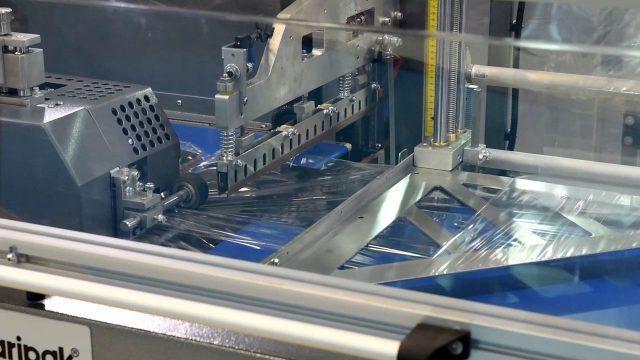
The packing process is carried out in several steps. Shrink film in the form of a roll is placed in the packaging machine. The film runs through a special mechanism that is on the sealing machine, opening the two layers of the film. The product and the film run in a parallel speed with each other placing the product on the folding center. Once the film covers the product, the sealers come into action to seal (weld) the two opposite sides of the film to each other.
Types of Sealers (Welding)
- L-Sealer (L Welding, L Sewing or L Cutting)
- Continuous Sealer (Side Sealer)
L-Sealer Shrink Packaging Machines
For the films in which all three sides need to be sealed, the first seal is done manually. Then the remaining two sides need to be sealed. In L-Sealing, this is done with the help of an L-shaped jaw.
Watch the video for an example of how the L-Sealer Shrink Packaging Machine works:
Continuous Sealer Shrink Packaging Machines
Continuous Sealer on the side act as a sewing machine that seals the shrink film that runs through in the production flow direction. This allows infinite sealing will be ensured in the length. The remaining side will be sealed with the help of a vertical jaw. Continuous Sealer Machines have two vertical jaw options. Intermittent vertical jaws and box motion/continuous motion vertical jaw. The right vertical sealer depends on a few variables such as the dimension of the product, production capacity.
Watch the video for an example of how the Continuous Sealer Shrink Packaging with an Intermittent Vertical sealing jaw works:
Watch the video for an example of how the Continuous Sealer Shrink Packaging with an Box-Motion/Continuous vertical sealing jaw works:
Efficiency in Shrink Packaging
Shrink packaging machine technology has become a long way in a short time. Servo motor technology has become the standard technology. Software and hardware integrations and the advanced communication between them have set the ground for the new advancements. The introduction of mechatronics made it possible for new ideas to be put into practice at the speed of light. Now, new functions can be added to the not only the shrink process itself but integrations such as check weighers, labelers, barcode readers etc. The project design departments are now taking the lead from production departments.
Shrink Packaging in the Production Process
Shrink packaging has a great place within the context of “flexible packaging”. It is used in a wide range of industries from food to automotive, textiles to stationery packaging.
Shrink packaging is the last phase of the production process and has an effect on the final cost of the product. Production facilities have taken serious measures in recent years despite falling profit margins in parallel with developing production infrastructure. Almost all of the manufacturers needed to reduce production costs and re-consider their production efficiency. This is why packaging efficiency is very important!
Time, quantity, and labor are the most important factors in the decision of choosing the right shrink packaging machine and the packaging cost. Single-stage, “tunnel-less” Shrink Packaging Machines can be shown as the entry-level examples of Shrink Packaging Machines. These machines have been a temporary solution for small and medium-sized companies for many years. However, these entry-level shrink packaging machines will not be able to meet the expectations in an industrial level high production capacity.
It’s not possible for an operator to feed the automatic machine with 100% efficiency. Even in the best conditions, it is necessary to calculate a feed-based loss of 20% in a hand-fed automatic machine. There are also “stop-and-go” losses in processes and simultaneous loss of labor. Therefore the product feeding unit in the packaging machine must be included in automation.
Common Problems in Packaging Operations
- Labor dependency
- Unit-time productivity losses
- Employment load
- Packing material losses
- Quality discrepancy
- Tracking cost of returning products from stores
- Damage to the brand
- Competition challenges
- Management and follow-up burden
- Losses due to unhealthy process flow
- Physical field losses in production
- Waste of used energy